Web scraping is less talked about but used widely for various purposes. People use it to gather business intelligence, monitor the prices of their products, conduct academic and medical research, and what have you.
You don’t need a business or academic purpose to pursue data scraping. A curious mindset will do just fine. Not to mention the benefits you can gain by gathering data (ethically) and monetizing it.
Numerous resources are available to help you understand and learn the art of scraping data from the web. It will be relatively easier for someone with a technical background. But fear not, this isn’t rocket science. All you need is a drive and one solid plan to follow.
Read on as we list the basic requirements, challenges, and considerations to master data scraping in this comprehensive guide.
Why Would You Want To Learn Data Scraping?
We’ve covered this question previously in the blog, “From Data to Insight: Explore the Various Applications of Data Scraping”. It includes four broader reasons for the web scraping/data scraping requirement.
For individual or personal use, technology has made it easier for you to obtain data with the advent of RPA (robotic process automation. You have tools at your disposal that require no coding at all. It begs the question, why would you even learn data scraping then?
To state some good reasons:
- The tools come with a subscription. Free trials have their limits and there is no guarantee you will get everything you want from the data collected. You can find some tools that charge only a nominal fee for year-long subscriptions.
- Even then, running these tools will require at least a surface-level understanding of website structure, components such as robot.txt file, and so on.
- Tools with various functionalities that let you perform complex data scraping may require at least basic or intermediate knowledge of any programming language.
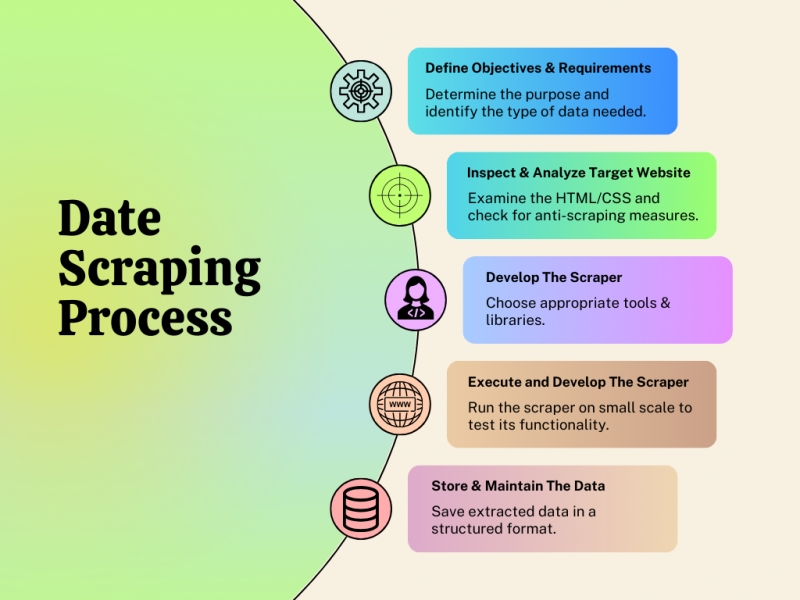
As is the case with everything, there is no “one-size-fits-all” solution to learning data scraping. This guide aims to help you cross the first level of difficulty, which is how to get started with data scraping. It will take you through the steps necessary to build your foundation, strengthen basic techniques, and take necessary precautions.
The Basics
- HTTP Protocols:
It is the foundation of data exchange on the web. You can send in proper requests to servers and interpret the responses correctly with a good understanding of HTTP.
You can easily handle different scenarios with the knowledge of status codes like 200 for success, 404 for not found, and 503 for service unavailable.
Knowing how to manage sessions with HTTP headers and cookies is essential to access content that requires authentication.
- Front-End:
To locate and extract the desired data, you need an understanding of the structure of web pages.
HTML (hypertext markup language) is used to define the structure of a web page. Identifying tags, attributes, and element hierarchy is the beginning of your data-scraping journey, which is why, familiarity with this language is essential.
With CSS selectors you can pinpoint and extract data elements accurately. It is particularly useful when using tools like BeautifulSoup or Scrapy.
- Important Practices:
These are terms you need to familiarize yourself with to grasp the basics.
Crawlers and Scrapers are programmed bots. They perform the task of crawling the allocated web pages and scraping the required data from those pages, respectively.
Data parsing is the process of analyzing a string of data and converting it into a readable format. HTML parsing is performed using libraries like BeautifulSoup or Cheerio. You can extract data from HTML documents.
JSON parsing involves using inbuilt functions in languages like Python and JavaScript. Libraries like LXML or DOMParser assist with XML Parsing.
Data cleaning is where you remove duplicates, handle missing values, correct errors, validate the data, and convert it into a consistent format.
The Foundations
- Programming Skills:
Python is the go-to language to begin with data scraping. Not only does it have understandable syntax, but it also hosts a large collection of libraries and frameworks that are specifically designed for data scraping.
Java Script is used in websites to load content dynamically. You need a good grasp of JavaScript to be able to scrape data that may not be present in the initial HTML source but completes loading via JS.
When integrated with front-end technologies, JS can be used to manipulate the Document Object Model (DOM) which is crucial for complex scraping tasks. It also allows you to handle events (clicks, form submissions) to navigate through the interactive elements of a website.
- Databases:
They provide efficiency in storing, managing, and retrieving the scraped data. You can process and analyze the data while ensuring its security thanks to the databases. You can handle different types of data at various scales upon acquiring proficiency.
You need to learn database design, indexing, normalization, and optimization techniques to manage and maintain databases. Learning how to integrate them into web scraping tools is equally important.
Relational databases use structured query language (SQL) for database management. They stored data in tables with rows and columns. Examples include MySQL, PostgreSQL, and SQLite.
NoSQL Databases like MongoDB, Cassandra, and CouchDB are schema-less, allowing for flexible data models. These can handle unstructured or semi-structured data.
- Headless Browsers:
These browsers run like any other browsers except they run in the background and do not display any user interface. These are highly useful for automated tasks.
Running without GUI makes them less resource-intensive and is suitable for automated testing or web scraping.
You can use scripts written in JavaScript, Python, or others via appropriate libraries.
Tools and Libraries
Any beginning point you opt for, you will find plenty of tools to make data scraping more convenient. What you use depends on the scale, complexity, and duration of the scraping process.
Libraries
Python Libraries for Data Scraping
- To parse HTML and XML documents to extract data easily, BeautifulSoup is widely and commonly used.
- Scrapy is best known for its powerful and versatile crawling, assisting you with complex web scraping tasks such as scraping websites with multiple pages and dynamic content.
- To scrape dynamic content that requires JavaScript execution, Selenium will be the ideal choice. It can interact with web pages like a real user would.
JavaScript Libraries for Data Scraping
- JavaScript has various powerful libraries like Puppeteer, a Node.js library that provides high-level API. It is useful in controlling headless browsers and rendering JavaScrapt-heavy pages.
- Cheerio is fast, flexible, and allows for easy parsing and manipulation of HTML.
- You can fetch data from APIs using the promise-based HTTP client, Axios.
Tools for Data Parsing and Cleaning
- Pandas offer extensive functions for data manipulation and cleaning.
- If you’re working with messy data, OpenRefine can aid you as a powerful tool.
- NumPy supports large multidimensional arrays and matrices with mathematical functions to operate on them.
- Excel and Google Sheets are the most basic tools that provide functions for cleaning data using formulae and scripts.
Challenges and Ethical Consideration in Data Scraping
- Dynamic Content: Websites that load content dynamically do not make their data available in the initial HTML. You need headless browsers to handle websites that load using JavaScript and Ajax.
- Anti-Scraping Measures: Rate limiting is implemented by many sites to restrict the number of requests from a single IP address within a certain time limit. Bypassing CAPTCHAs can be difficult as they prevent automated access. You need VPNs or rotating proxies to help mitigate the IP Blocking resulting from repeated scraping.
- Legal and Ethical Issues: Things can go south if you do not comply with a website’s Terms of Service, leading to legal action. Scraping personal data can be flagged as a violation of privacy and a breach of data protection regulations.
Scraping Website With Python Script Using Beautiful Soup
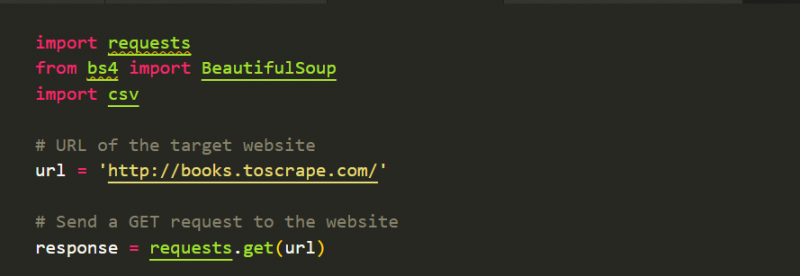
For this demo, we will scrape a popular website Books to Scrape. It is an online bookstore with data on titles, prices, ratings, and availability.
- Import the library and send a get request to the website.
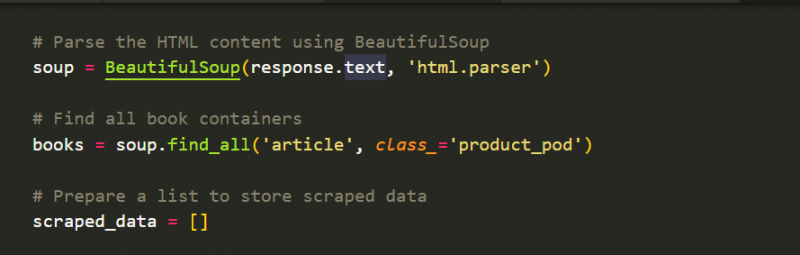
- Parse the Content
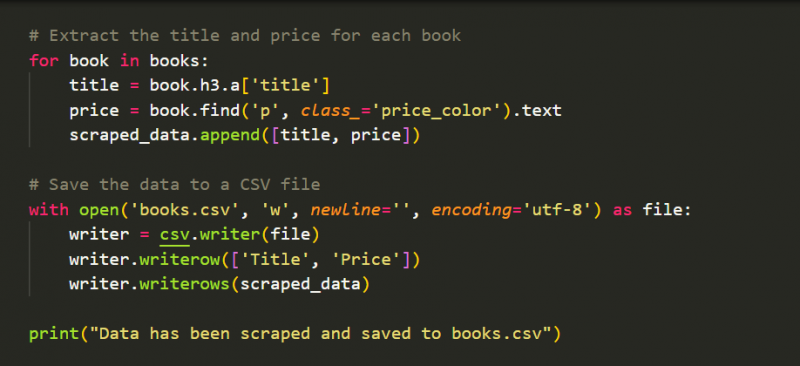
- Extract and Store the Data
Scraping Website With JavaScript Using Puppeteer
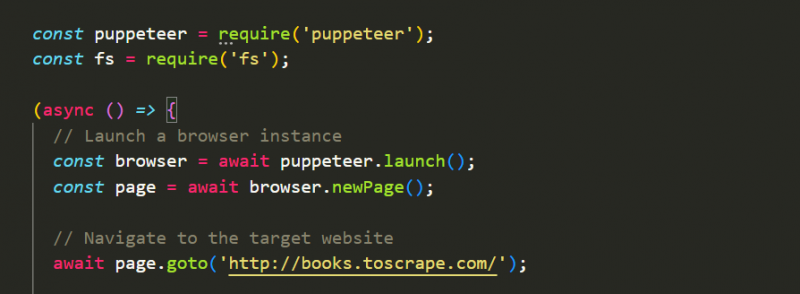
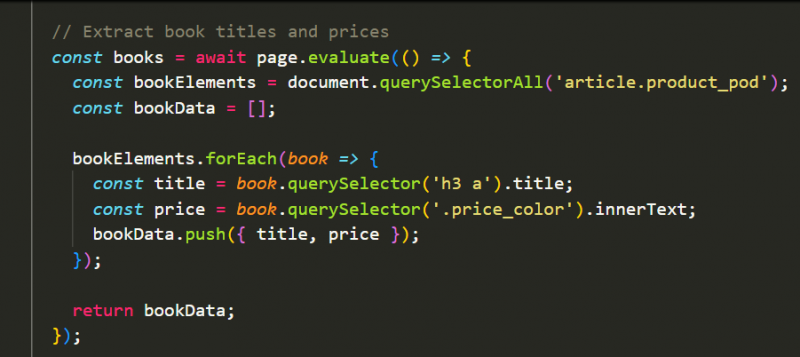
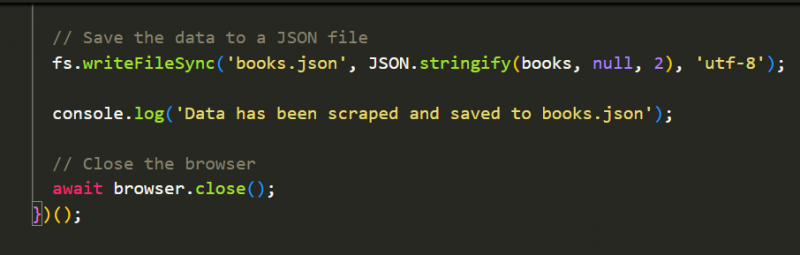
- Script to scrape the same demo website using JavaScript
Conclusion
Data scraping is valuable for extracting information from websites at various scales and with different complexities. It has numerous benefits and challenges of its own.
Although not illegal, some sites require you to comply with their regulations, copyright laws, and the robot.txt file which tells what you can scrape from the concerned website.
Learning to scrape data will benefit you greatly if perfected and practiced ethically.
