Business decisions depend on data that lives outside your organization. Competitor prices, product catalogs, customer sentiment, job postings, real estate listings, and regulatory filings all sit on public websites. Collecting this manually is slow, incomplete, and outdated before it reaches a spreadsheet.
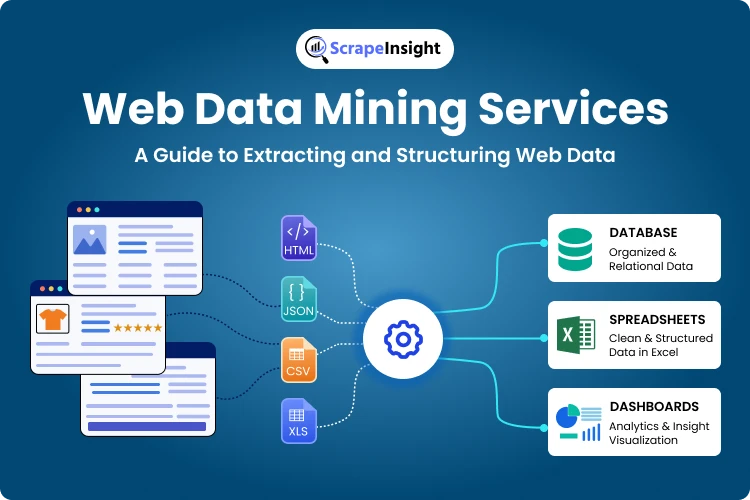
Web data mining services solve this by automating the extraction, cleaning, and structuring of publicly available web content. Unlike basic web scraping, which often delivers raw HTML dumps, data mining services transform scattered online information into analysis-ready datasets that feed directly into business intelligence tools, pricing engines, and machine learning models.
What Are Web Data Mining Services
Web data mining services combine automated extraction with data processing, normalization, and quality validation to deliver structured intelligence from online sources. The process includes:
- Target identification: Defining the websites, pages, and data fields needed for the project
- Automated extraction: Crawling and parsing web content using bots, APIs, or browser automation
- Data cleaning: Removing duplicates, fixing formatting errors, and filtering irrelevant records
- Normalization: Converting raw data into consistent schemas with standardized units, currencies, and categories
- Enrichment: Adding context such as geocoding, sentiment scores, or entity matching
- Delivery: Providing output in formats such as CSV, JSON, XML, or direct API feeds into databases and dashboards
The key distinction from basic web scraping is the processing layer. Scraping pulls content. Mining turns that content into something you can analyze without additional engineering work.
Web Data Mining vs Web Scraping: What Is the Difference
The terms are often used interchangeably, but they describe different levels of service.
| Aspect | Web Scraping | Web Data Mining Services |
|---|---|---|
| Output | Raw HTML, text, or unstructured files | Clean, structured, analysis-ready datasets |
| Processing | Minimal or none included | Data cleaning, normalization, and enrichment standard |
| Scale | Often limited to small site sets | Built for high volume across hundreds or thousands of sources |
| Maintenance | The client handles parser updates when sites change | The provider monitors and adapts to layout changes |
| Anti-bot handling | Basic proxy rotation | Sophisticated fingerprint management, CAPTCHA solving, and session persistence |
| Integration | Requires internal engineering to format and load | Direct delivery to databases, BI tools, or cloud storage |
If your team needs raw content for a one-time research project, scraping may suffice. If you need ongoing, structured intelligence that feeds operational systems, data mining services are the appropriate choice.
Who Uses Web Data Mining Services
The demand for web data mining spans industries and functions. Common users include:
E-commerce and retail teams
Monitor competitor pricing, product assortment, promotional timing, and inventory levels across marketplaces and direct-to-consumer sites. Use the data to adjust pricing strategies, identify gaps in product lines, and time promotional campaigns.
Market research and consulting firms
Track industry trends, consumer sentiment, and competitive positioning across public sources. Build datasets for market sizing, brand perception studies, and industry reports without relying on static surveys.
Real estate and investment analysts
Collect property listings, rental rates, occupancy signals, and neighborhood amenities from portals and classified sites. Identify undervalued markets and track supply changes.
Recruitment and HR platforms
Aggregate job postings, salary ranges, skill requirements, and company hiring patterns from multiple boards. Map labor market trends and identify talent gaps.
Financial services and compliance
Monitor regulatory filings, news sentiment, executive movements, and competitor announcements. Track alternative data signals for investment decisions.
Travel and hospitality
Collect hotel rates, flight prices, availability calendars, and guest reviews from booking platforms and metasearch engines. Build comparison tools and market intelligence dashboards.
Curious how this works for hotels and travel platforms?
ScrapeInsight also tracks hotel rates, availability, and guest reviews across booking platforms for travel and hospitality teams.
Healthcare and pharmaceutical researchers
Gather clinical trial listings, drug pricing, physician directories, and research publications from public databases and regulatory sites.
Types of Data You Can Mine from the Web
| Category | Examples |
|---|---|
| Pricing and product data | Prices, discounts, stock levels, product descriptions, specifications, images, SKUs |
| Text and sentiment | Reviews, comments, social media posts, forum discussions, news articles, blog content |
| Business listings | Company names, addresses, contact details, employee counts, and industry classifications |
| Job and talent data | Job titles, descriptions, salaries, locations, required skills, posting dates |
| Real estate | Property prices, rental rates, square footage, amenities, listing dates, and agent details |
| Travel and hospitality | Hotel rates, room types, availability, flight prices, guest reviews, and property amenities |
| Regulatory and legal | Filings, permits, court records, compliance notices, patent publications |
| News and media | Article text, publication dates, author information, topic tags, engagement metrics |
Common Sources for Web Data Mining
| Source Type | Examples | Data Typically Mined |
|---|---|---|
| E-commerce marketplaces | Amazon, eBay, Walmart, Target, Shopify stores | Product catalogs, pricing, reviews, and inventory |
| Travel platforms | Booking.com, Expedia, Airbnb, TripAdvisor | Rates, availability, reviews, and property details |
| Real estate portals | Zillow, Realtor.com, Apartments.com | Listings, prices, amenities, agent contacts |
| Job boards | LinkedIn, Indeed, Glassdoor | Postings, salaries, and company hiring patterns |
| Social and review sites | Reddit, Twitter/X, Yelp, Trustpilot | Sentiment, mentions, customer feedback |
| News and publications | Major outlets, industry blogs, and press release sites | Article content, announcements, trend signals |
| Government and regulatory | SEC EDGAR, FDA, EU portals, patent offices | Filings, approvals, compliance records |
| Business directories | Yellow Pages, Crunchbase, industry associations | Company profiles, contact data, and funding events |
Why Internal Scraping Projects Fail
Many organizations attempt to build web data mining internally before switching to managed services. The common failure points are predictable:
Anti-bot complexity
Modern websites deploy sophisticated detection systems that analyze IP reputation, browser fingerprints, request patterns, and mouse movements. A script that works in development is often blocked in production. Maintaining proxy pools, rotating user agents, and solving CAPTCHAs require dedicated infrastructure and constant attention.
Structural fragility
Websites redesign their layouts, rename CSS classes, and restructure HTML regularly. Each change breaks the selectors that parsers rely on. Without active monitoring, an internal scraper can produce empty or corrupted data for weeks before anyone notices.
Data normalization burden
Raw extraction is rarely usable. The same product might be listed as “iPhone 15 Pro 256GB” on one site and “Apple iPhone 15 Pro (256 GB)” on another. Prices may include or exclude taxes. Dates might use different formats. Turning this into a unified dataset requires mapping logic that most teams underestimate.
Scaling costs
What works for ten pages often fails for ten thousand. Crawling at scale requires a distributed architecture, queue management, deduplication, and storage optimization. These engineering costs exceed the budget of most non-technical teams.
Maintenance overhead
A production data mining system is not a one-time project. It is an ongoing product that requires monitoring, alerting, parser updates, and proxy management. For teams whose core competency is not data extraction, this overhead eventually exceeds the value of keeping the work internal.
These challenges are common in grocery and delivery platform scraping too.
Constant price updates, stock changes, and location-based listings make grocery delivery data especially prone to breaking scrapers.
How Managed Web Data Mining Services Work
Managed providers handle the full pipeline from extraction to delivery. A typical service engagement includes:
Requirement scoping
The provider works with your team to define target sources, data fields, refresh frequency, and output formats. This phase establishes the schema and business rules that govern the project.
Crawler development
Engineers build custom extraction logic for each target site. This includes handling JavaScript rendering, mobile app endpoints, and authentication where necessary. The crawlers are designed to adapt to structural changes.
Proxy and access management
The provider manages IP rotation, browser fingerprinting, request throttling, and CAPTCHA solving to maintain reliable access without triggering blocks.
Data processing and normalization
Raw extraction is cleaned, deduplicated, and mapped to a consistent schema. Units, currencies, and categories are standardized. Entity matching aligns records across sources.
Quality assurance
Automated checks detect outliers, missing fields, and unexpected changes. Alerts flag issues before corrupted data reaches your systems.
Scheduled delivery
Data is delivered via API, file transfer, or direct database integration on the agreed schedule. Formats include CSV, JSON, XML, or custom structures.
Ongoing maintenance
When target sites update their layouts or protection systems, the provider adapts the extraction logic without requiring your involvement.
Choosing Between DIY, Tools, and Managed Services
| Approach | Best For | Pros | Cons |
|---|---|---|---|
| DIY scripting | One-time projects, technical teams with spare capacity | Full control, no vendor cost | High maintenance, fragile at scale, normalization burden |
| Scraping tools (Octoparse, ParseHub) | Small projects, non-technical users | Low-cost, visual interfaces | Limited scale, no normalization, weak anti-bot handling |
| Developer APIs (ScrapingBee, Zyte) | Engineering teams building custom pipelines | Flexible, good for dynamic sites | Requires coding, no data processing included |
| Managed services (ScrapeInsight, GroupBWT) | Ongoing business intelligence needs | End-to-end processing, maintenance included, scalable | Higher cost than DIY, requires scoping upfront |
Most organizations start with DIY or tools, encounter the maintenance and scaling issues described above, and then migrate to managed services for production workloads.
Get Structured Web Data Without the Engineering Burden
Websites change their layouts, protection systems, and data formats regularly. An extraction system that does not actively adapt will quietly deliver incomplete datasets, stale records, or corrupted output.
ScrapeInsight provides managed web data mining services built for long-term consistency. From handling dynamic content and anti-bot measures to ensuring structured delivery and data accuracy across sources, we manage the complexity so your team can focus on analysis and decision-making.
If you need web data that arrives on schedule, matches across platforms, and stays accurate when target sites update, contact ScrapeInsight to discuss your requirements.
