A major rental chain adjusts its economy car rates at LAX six times before noon. A peer-to-peer host on Turo drops a weekend SUV price after watching three nearby listings go unsold. A fleet operator in Phoenix notices competitor availability drying up before spring break and raises rates 40% while demand is still building. By the time a revenue manager finishes checking one airport by hand, the market has already moved.
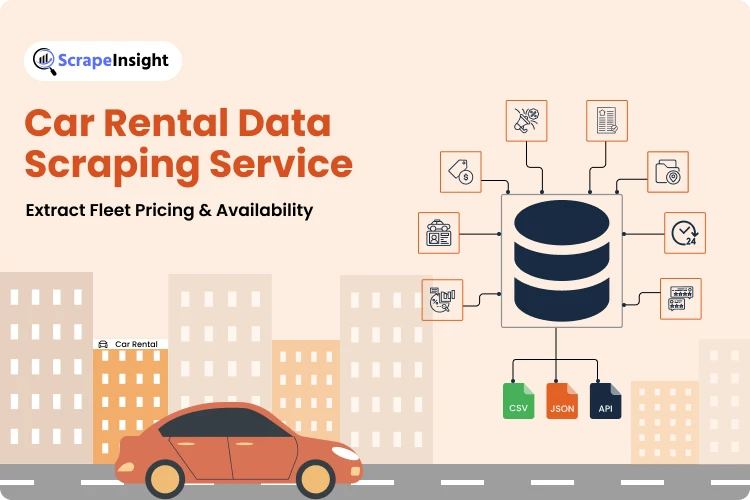
Car rental data scraping automates the extraction of pricing, availability, fleet composition, and customer sentiment from rental platforms. Done well, it produces structured datasets that power dynamic pricing, fleet allocation, and competitive positioning. Done poorly, it delivers stale rates, incomplete inventory counts, and IP bans that eat your engineering team’s time.
What Is Car Rental Data Scraping
Car rental data scraping is the automated collection of publicly available rental vehicle information from websites and mobile apps. Sources include traditional rental companies, peer-to-peer platforms, travel aggregators, and corporate booking portals.
Want to understand the full process behind this, from extraction to clean, structured data? Read our guide to web data mining services.
A typical extraction pipeline includes:
- Crawling target platforms with search parameters such as pickup location, dates, vehicle class, and driver age
- Identifying relevant data fields such as rates, availability, vehicle specs, and fees
- Extracting structured information from HTML, JavaScript-rendered content, or mobile app APIs
- Cleaning and validating data to remove duplicates, test inventory, and placeholder listings
- Normalizing output into consistent schemas for analysis or direct system integration
Rental rates and availability shift constantly, so these pipelines typically run on schedules ranging from hourly to daily. More advanced setups also handle dynamic pricing algorithms, geo-targeted rate variations, mobile app endpoints, and the anti-bot protections major platforms deploy.
Who Uses This Data and What They Do With It
Six types of buyers rely on rental data, each for a different job.
Fleet operators and traditional rental companies use competitive pricing data to adjust their own rates dynamically. They track which vehicle classes are in high demand at specific locations, identify when competitors sell out, and rebalance fleet allocation between airport and city locations based on real booking patterns.
Peer-to-peer rental hosts and platforms track local market pricing to set competitive rates. They flag underpriced listings as booking opportunities, monitor which vehicle categories command premium rates in specific neighborhoods, and adjust availability for seasonal demand.
Travel aggregators and online travel agencies build comparison engines that need live data from multiple providers. They verify displayed rates match checkout prices, catch rate parity violations between direct and third-party channels, and package car rentals with flights and hotels for bundled pricing.
Corporate travel managers audit negotiated rate compliance across booking channels. They compare corporate rates against public availability to find savings, track whether employees book preferred vehicle categories and insurance coverage, and monitor policy compliance across thousands of annual bookings.
Market researchers and investment analysts build datasets for market entry evaluation, M&A due diligence, and industry trend analysis. They track the shift from traditional rentals to peer-to-peer and subscription models, monitor fleet composition changes like EV adoption, and flag regional saturation or growth.
Insurance and mobility providers benchmark rental insurance pricing and coverage options. They track vehicle types and usage patterns for risk modelling, monitor fleet turnover and maintenance cycles, and flag emerging mobility trends that affect underwriting.
What Data You Can Collect From Car Rental Platforms
Car rental platforms expose ten categories of data, from vehicle identity to market context.
| Category | Data Points |
|---|---|
| Vehicle identity | Make, model, year, vehicle class, transmission, fuel type, passenger capacity, luggage capacity |
| Pricing | Daily rate, weekly rate, monthly rate, total estimated cost, taxes, fees, insurance options, deposit requirements |
| Availability | Real-time availability, booking calendar, sold-out status, limited inventory alerts, booking windows |
| Location data | Pickup and drop-off locations, airport vs. city vs. neighborhood, operating hours, shuttle availability, one-way rental options |
| Rental terms | Minimum age, driver requirements, mileage limits, fuel policy, cancellation terms, grace periods |
| Fees and extras | Additional driver fees, young driver surcharges, GPS rental, child seat, toll pass, roadside assistance, one-way drop-off fees |
| Reviews and ratings | Overall score, vehicle condition ratings, cleanliness, pickup experience, customer service, management responses |
| Fleet composition | Vehicle age distribution, hybrid and EV availability, luxury and specialty vehicle counts |
| Promotions | Discount codes, loyalty program rates, early booking discounts, corporate rates, package deals |
| Market context | Search ranking, sponsored placement, badge status, cross-sell recommendations, competitor proximity |
Where Car Rental Data Lives: Sources and Limitations
Eleven platform types carry rental data, and each comes with its own access problems.
| Source | What It Provides | Limitations |
|---|---|---|
| Hertz | Global fleet data, Gold Plus Rewards integration, premium vehicle classes, corporate rates | Heavy anti-bot protection, regional pricing variations, frequent site updates |
| Enterprise | Largest US fleet, neighborhood and airport locations, service data | Complex rate structures, franchise vs. corporate location variations |
| Avis | Business traveler focus, Avis Preferred loyalty rates, airport presence | Higher base pricing, limited peer-to-peer competitive context |
| Budget | Value segment positioning, basic vehicle classes, promotional pricing | Smaller fleet data depth, limited luxury vehicle coverage |
| National | Emerald Club loyalty data, business travel focus, streamlined service | Primarily North American coverage, less leisure market data |
| Sixt | European luxury and premium fleet, sports car availability, younger vehicle age | Limited US coverage, premium positioning without budget context |
| Turo | Peer-to-peer listings, host ratings, vehicle condition details, flexible pickup | Host-controlled availability, variable data quality, insurance complexity |
| Getaround | Hourly and daily rentals, connected car technology, urban focus | Smaller inventory than Turo, limited geographic coverage |
| Kayak | Aggregated comparison data, opaque pricing, multi-provider search | Cached data may lag real-time rates, limited direct booking detail |
| Priceline / Hotwire | Express deals, opaque pricing, last-minute discounts | No provider identification until after booking, limited fleet detail |
| Booking.com | Global coverage, integrated travel packages, review aggregation | Car rental is secondary to hotel focus, less specialized data |
| Europcar | European and international coverage, fleet diversity, green vehicle options | Varies significantly by country, less detailed in non-European markets |
Why Car Rental Data Is Harder to Capture Than Most Ecommerce
Retail e-commerce has standardised product pages: one price, one size selector, and one add-to-cart button. Car rental platforms don’t work that way. The same vehicle class carries different names across platforms, the same location shows different inventory depending on the channel, and the same dates produce different rates depending on whether the searcher is logged in, on mobile, or browsing from a different city.
Opaque pricing architecture
The displayed daily rate is rarely the final cost. Taxes, airport fees, concession recovery charges, vehicle licensing fees, and insurance options accumulate through the booking flow. A rate that looks competitive at search can run 40% higher at checkout. Capturing the real cost means simulating the full reservation process, not scraping the results page.
Dynamic and personalized pricing
Rental companies adjust rates based on demand forecasts, competitor positioning, local events, and inventory levels. They also personalise by loyalty status, browsing history, device type, and geographic origin. A scraper running from one IP address sees a different market than a user searching from somewhere else.
Fragmented inventory systems
A single rental location can list vehicles on its own website, on aggregator platforms, on corporate booking portals, and on peer-to-peer marketplaces at the same time. Each channel carries different availability, pricing, and terms. No single source gives you the complete picture.
Frequent structural changes
Rental platforms redesign their search interfaces, booking flows, and rate displays on a regular cycle. Each redesign breaks the extraction logic built for the previous version. A scraper that worked last quarter can fail silently this quarter, returning empty data with no alert.
Anti-bot measures
Major platforms run detection systems that monitor IP reputation, request patterns, browser fingerprints, and mouse movements. They serve CAPTCHAs, throttle requests, and block data centre IP ranges. Staying online requires rotating residential and mobile proxies, managing session persistence, and mimicking human browsing behaviour.
Ready to Get Reliable Car Rental Data With ScrapeInsight
Rental platforms change their layouts, anti-bot systems, and pricing algorithms often. A scraper that doesn’t adapt will quietly return incomplete rate sets, outdated availability, or missing competitor data, and you may not notice until a pricing decision goes wrong.
ScrapeInsight runs managed car rental data pipelines built for that kind of change. We handle proxy rotation and anti-bot evasion; rebuild extraction logic when target sites redesign; and normalise output into the schema your pricing or BI tools expect across locations, vehicle classes, and booking channels.
If you need car rental data that arrives on schedule, matches across platforms, and stays accurate when target sites update, contact ScrapeInsight to discuss your requirements.