A bid manager can lose an entire morning searching Contracts Finder for opportunities that match a handful of CPV codes.
Then the real work starts.
Relevant notices sit next to below-threshold opportunities that don’t belong on their pursuit list. Some contracts appear on Contracts Finder, others only on Find a Tender, and a fair number show up on both with slightly different details. Award notices are published separately from the original opportunity. Deadlines shift after an amendment goes live, often without any change to the notice’s headline fields.
For a UK GovCon business development team, the problem isn’t finding one contract. It’s keeping up with the volume and fragmentation of public sector procurement data without someone manually checking two government portals every day. That’s the exact gap ScrapeInsight’s government contract scraping service is built to close, turning scattered UK procurement notices into one structured, searchable dataset.
What Is UK Contracts Finder Data Scraping?
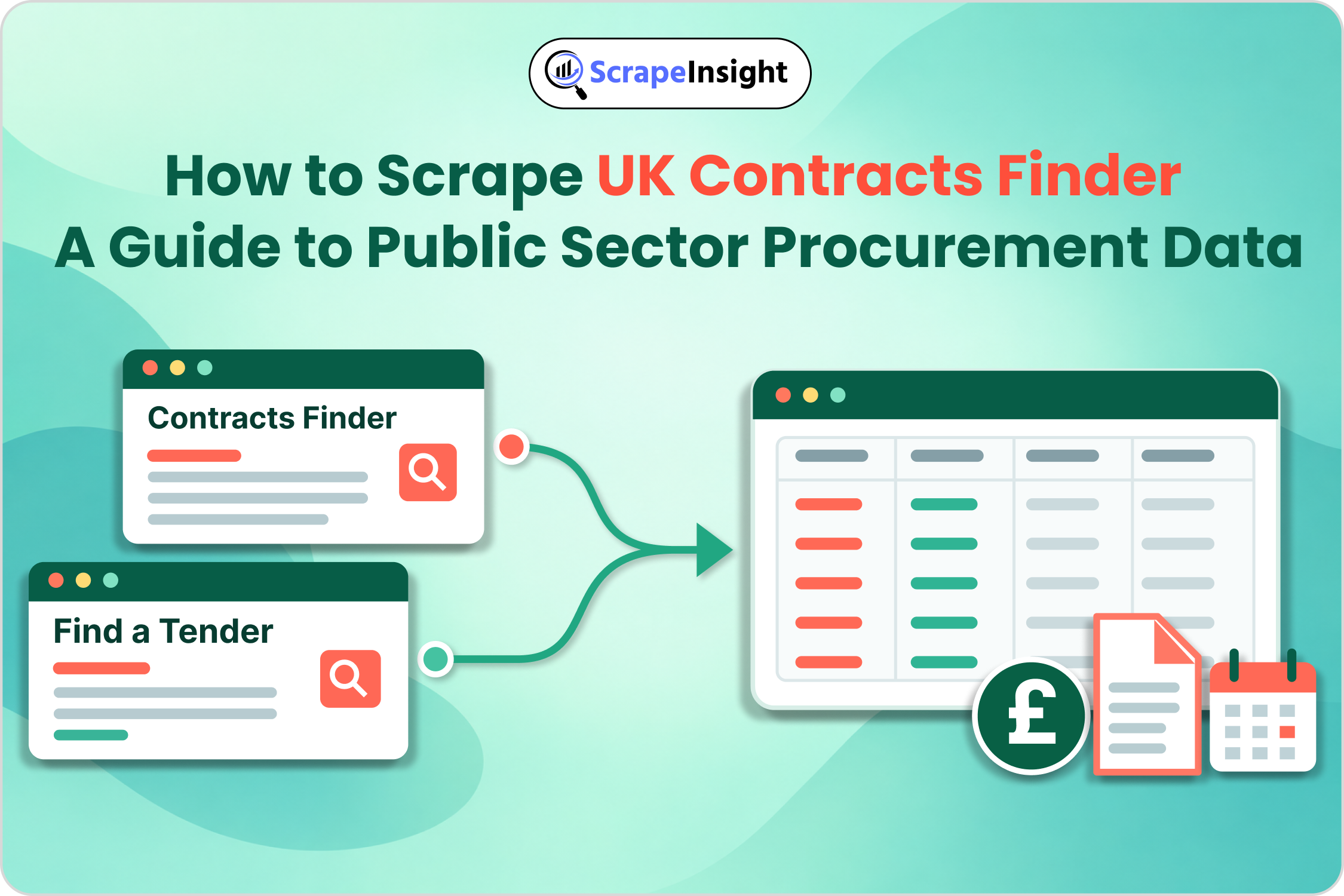
UK Contracts Finder scraping is the automated collection of publicly available procurement information from Contracts Finder, Find a Tender, and related UK public sector data sources.
For a supplier chasing public sector work, that means pulling far more than a notice title. A useful dataset typically includes:
- Notice ID or OCID (Open Contracting ID)
- Contract title and description
- Buying organisation and contracting authority
- CPV (Common Procurement Vocabulary) code
- Procurement stage: planning, tender, or award
- Publication date and response deadline
- Contract value and currency
- Location or place of performance
- Contract duration
- Award information and winning supplier
- Buyer contact details, where published
- Attached documents and specifications
- Amendments and notice updates
- Source notice URL
The goal is to turn two separate government feeds into one dataset a business development or capture team can actually search and act on. That’s precisely what ScrapeInsight’s UK procurement pipelines are built to deliver.
Where UK Public Sector Contract Data Comes From
Contracts Finder
Contracts Finder is the GOV.UK platform for public sector procurement opportunities. It covers contracts published by central government departments, local authorities, and other public bodies.
The platform lists both open opportunities and contracts already awarded. Suppliers can search by keyword, location, or procurement stage, then filter by date range, contract value, or CPV code. Results download as XML or CSV.
Contracts Finder mainly carries below-threshold notices, plus a share of above-threshold contracts and award notices.
For a supplier scanning opportunities manually, this is usually the first stop. It’s also where manual monitoring stops scaling, once the search needs to run across multiple buyers, CPV codes, and value bands at once. ScrapeInsight replaces that manual search with a continuously updated feed.
Find a Tender Service (FTS)
Find a Tender is the UK’s statutory publication point for above-threshold public procurement notices, run by the Cabinet Office. It replaced the EU’s OJEU and TED systems after the Brexit transition period.
Under the Procurement Act 2023, Find a Tender is now the mandatory first point of publication for regulated above-threshold contracts before they appear anywhere else, including Contracts Finder.
Thresholds separating “below” from “above” vary by contract type. Central government contract awards over £12,000 (including VAT) publish on Find a Tender, and supplies-and-services and works contracts each carry their own higher thresholds.
Contract values must also be calculated inclusive of VAT under the Procurement Act 2023, which changes which side of the threshold a contract lands on compared to the pre-2025 rules.
A pipeline built around last year’s threshold figures can quietly misclassify contracts the moment the numbers update. Catching and correcting that drift automatically is exactly what ScrapeInsight’s pipelines are built to do.
Devolved and regional portals
England-focused coverage isn’t the whole picture. Scotland publishes through Public Contracts Scotland, Wales through Sell2Wales, and Northern Ireland through its own eSourcing platform.
A supplier bidding UK-wide needs data from all of these alongside Contracts Finder and Find a Tender, each with its own structure and update cadence.
What Data Should You Scrape From UK Government Contracts?
The right dataset depends on what it’s used for. A capture team hunting new opportunities needs different fields than a market intelligence firm tracking competitor award history.
- Opportunity data: notice ID, title, buyer, contracting authority, CPV code, procurement stage, posted date, response deadline, and estimated value. This is what a BD or capture team needs to decide whether an opportunity deserves attention.
- Scope and requirements: the notice summary rarely tells the full story. The real requirements sit inside attached Invitation to Tender (ITT) documents, specifications, pricing schedules, and evaluation criteria, frequently as PDFs. ScrapeInsight’s pipelines extract these documents directly, including OCR for scanned files, so a capture team gets the full requirement, not just the headline.
- Award information: awardee, award value, award date, contracting authority, and contract duration. This answers a more useful question than “what’s open right now”: it shows who is already winning the work and under what terms.
- Amendments and updates: a notice can change after publication. A deadline moves. A specification gets revised. A new document gets attached, sometimes without touching the notice’s headline fields at all. ScrapeInsight’s monitoring tracks these changes as they happen, so a moved deadline shows up as an alert instead of a missed opportunity.
Why UK Government Contract Data Is Difficult to Collect
- The data splits across multiple portals with different rules: Contracts Finder, Find a Tender, and three separate devolved platforms each carry different notice types under different thresholds. A contractor monitoring the whole UK market needs all five sources reconciled into one view, not five separate browser tabs.
- The useful information sits inside documents, not notice pages: a Contracts Finder listing might show the basic opportunity details while the real scope of work sits in a lengthy PDF, sometimes scanned and unreadable without OCR. A serious procurement workflow has to extract both the notice and its attachments, since either one alone is incomplete.
- Thresholds and rules change on a schedule: Financial thresholds get reviewed every two years, and the VAT-inclusive valuation rule introduced under the Procurement Act 2023 shifted which contracts count as above-threshold. A scraper built around outdated rules starts misclassifying contracts without producing an obvious error.
- Procurement information keeps moving after publication: New notices appear daily. Existing notices receive amendments. Awards get published later, sometimes on a different portal than the original opportunity. A dataset that isn’t monitored continuously can go from accurate to outdated without anyone noticing until a deadline is missed.
- Manual research doesn’t scale: Checking a handful of opportunities by hand works fine at small volume. It becomes a real operational cost once a business needs to monitor multiple portals, dozens of CPV codes, hundreds of keywords, and competitor award activity all at once. ScrapeInsight exists precisely to take this off a capture team’s plate, so the team spends its time on bids instead of on searching for them.
Who Uses UK Government Procurement Data?
- Government contractors and capture teams: use procurement intelligence to identify opportunities, understand buyer patterns, and research incumbent suppliers before committing capture resources to a pursuit.
- Business development teams: use structured contract data to prioritise buyers where the company has a realistic chance of winning, rather than spreading effort evenly across every open notice.
- GovCon market intelligence firms use contract and award records to build research products, benchmark competitors, and track shifts in UK public spending over time.
- Public sector sales and marketing platforms need a continuously updated procurement feed to power search, alerts, and dashboards inside their own product, exactly the kind of feed ScrapeInsight builds and maintains for its clients.
- Recruitment and staffing companies: use procurement activity to identify contractors likely to hire when they win new work, ahead of that hiring becoming publicly visible elsewhere.
Government Contract Scraping for Competitive Intelligence
The opportunity side is only half the picture. Historical award data reveals patterns that are directly useful for business development:
- Which buyers purchase the supplier’s type of service
- Which contractors win those awards most often
- Typical contract values by CPV code
- How often contracts get rebid
- Which local authorities or NHS trusts have increasing demand
- Where competitors are winning new ground
The same underlying data supports direct competitor tracking too: monitoring awards tied to specific competitors to see which buyers, categories, or regions are producing the most activity for them. ScrapeInsight builds this kind of tracking directly into a client’s ongoing data feed, so competitor activity shows up automatically instead of requiring a fresh manual search every quarter.
Government Contract Scraping for Opportunity Monitoring
For an active capture or BD team, speed decides whether an opportunity gets pursued at all. A useful monitoring setup continuously identifies new opportunities matching predefined criteria, including:
- Buyer or contracting authority
- CPV code
- Keywords
- Location
- Contract value
- Notice type and procurement stage
- Response deadline
Instead of a researcher checking Contracts Finder and Find a Tender every morning and hoping nothing slips through, ScrapeInsight collects, filters, and delivers matching records automatically, across every UK portal a client needs monitored. That turns the job from searching for everything into reviewing only what actually matters.
How ScrapeInsight Delivers UK Government Contract Data
ScrapeInsight provides managed scraping and procurement data services for UK-facing businesses that need structured public sector data without building and maintaining the collection infrastructure themselves. That includes:
- Multi-portal coverage: Contracts Finder, Find a Tender, and the devolved platforms, unified into one dataset instead of five separate feeds.
- Document extraction: ITTs, specifications, and pricing schedules pulled and OCR’d where needed, not just the notice summary.
- Threshold and rule tracking: pipelines built to reflect current thresholds and VAT-inclusive valuation, updated as the rules change.
- Amendment monitoring: deadline changes, revised specifications, and new attachments tracked as they’re published, not discovered after the fact.
- Award and competitor tracking: historical award data structured for market intelligence and competitor research, not just open opportunities.
- Delivery on your terms: structured output through an API, database, CRM, or scheduled export, built around the system your team already uses.
Tell us which portals, CPV codes, buyers, or award data you need tracked, and the ScrapeInsight team will scope the right UK procurement data workflow for you.