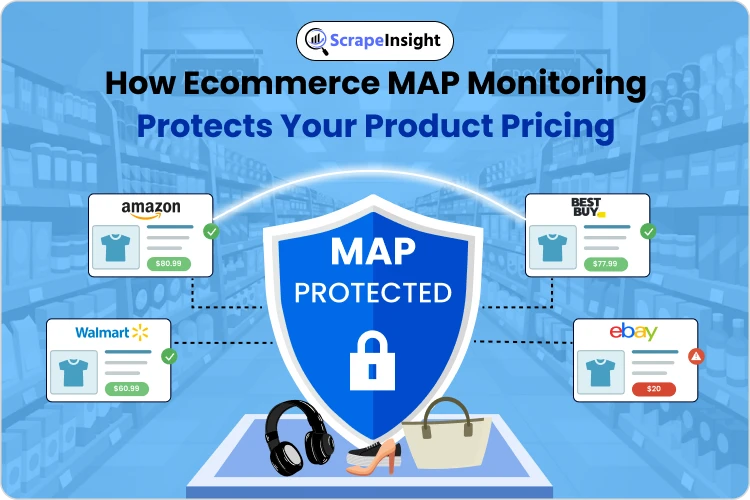
A buyer looking for your product rarely stops at one site. They check it on Amazon, open a couple of tabs for other marketplaces, maybe glance at a smaller niche store too, and buy wherever the price is lowest.
If one of those platforms is showing your product below MAP, that is where the sale goes, and you likely will not find out until a retailer complains or your numbers start looking off somewhere you were not watching.
This is where MAP monitoring comes in. In this guide, we will explain what MAP is, why it breaks down so easily once you are selling across many different e-commerce channels at once, and how automated monitoring helps brands catch violations before they cause real damage.
What Is MAP?
MAP stands for Minimum Advertised Price. It is a rule that brands set for their retailers and resellers. The rule is simple: you can sell my product for whatever price you want in person, but you cannot advertise it online below this set price.
Here is an easy example. A skincare brand sets a MAP of $40 for its face cream. A retailer can technically sell the product for $32 during checkout. But they cannot list it publicly at $32. The advertised price must stay at $40 or higher.
Brands use MAP to protect two things: their image and their retailer relationships. If one seller starts advertising a product for cheap, it makes the brand look less premium. It also creates unfair competition. Retailers who followed the rules end up losing sales to the ones who did not.
What Is Ecommerce MAP Monitoring?
Ecommerce MAP monitoring is the process of tracking product prices across every online channel where your product is sold and flagging any listing that drops below the MAP you have set. Instead of a person manually checking listings now and then, monitoring tools scan marketplaces, retailer sites, and your own store on a set schedule, then alert you the moment a price falls out of line.
The part that makes this different from monitoring a single platform is the word “every”. You are not tracking one site with one layout and one set of sellers. You are tracking your brand’s presence across an open-ended mix of marketplaces, direct retailer sites, and regional stores, each with its own structure, its own seller base, and its own blind spots. A setup that only watches one or two channels well is still leaving most of the exposure uncovered.
What MAP Monitoring Tracks
A MAP monitoring setup is not just watching one number. To actually be useful across many different sites, it needs to capture the full picture around every listing. Here is what that typically includes:
- Advertised price: The core number is being checked against your MAP for every product, on every listing, every time it is scanned.
- Seller or retailer name: Who is running the listing, so you know exactly who to follow up with.
- Product identifiers: SKU, UPC, or barcode, so the system matches the right listing to the right product even when titles or descriptions vary across sites.
- Listing URL: A direct link to the exact page, so you can go straight to the violation instead of searching for it.
- Timestamp: The date and time the price was captured, which matters most for violations that only last a few hours.
- Screenshot or price history: Visual proof of what was shown at that moment, useful if you need to raise the issue with a retailer or marketplace later.
- Channel or platform: Which marketplace or site the listing is on, since the same seller might comply on one platform and violate on another.
Together, this turns a simple price check into something you can actually act on. A number alone tells you a violation happened. The seller name, link, and timestamp tell you who, where, and when, which is what you need if you plan to follow up.
Why Do MAP Violations Happen on Ecommerce?
MAP rules existed long before e-commerce. Back when products were sold mostly through physical stores and a handful of catalogues, checking prices was manageable. A brand could call a few stores or send someone to check shelves.
Ecommerce changed everything. Today, a single product might be listed by:
- The brand’s own website
- Amazon, sold by dozens of different third-party sellers
- Walmart and other big marketplaces
- Smaller niche e-commerce sites
- Regional or international resellers
Each of these channels has its own sellers, its own price changes, and its own patterns. A brand manager cannot realistically open ten different websites every day and check hundreds of listings by hand. Even if they tried, they would only catch a small fraction of what is actually happening.
That gap between how many channels exist and how much a person can realistically watch is exactly why violations keep slipping through. It is not that brands do not care. It is that manual checking simply cannot keep pace with how spread out e-commerce has become.
The Weekend Blind Spot Nobody Talks About
Here is something most brands do not realise until it costs them money.
Many sellers know exactly when brands are watching. Monday to Friday, during business hours, someone from the brand’s team might be checking prices. But on weekends, and especially late at night, nobody is looking.
Some sellers use this gap on purpose. They drop the price on a Saturday, run a quiet flash sale, and then quietly raise it back up before Monday morning. By the time anyone checks again, everything looks normal. The violation already happened, and there is no record of it.
This is one of the tricks that manual price checking almost always misses, since it usually only happens during standard business hours.
This is exactly why automated monitoring across every channel matters so much. A system that checks prices continuously does not take weekends off. It does not sleep. It catches the Saturday night price drop the same way it catches a Tuesday afternoon one.
Want to scrape Home Depot for pricing and product data?
Home Depot’s listings shift often across categories, stores, and stock status, which makes manual tracking unreliable. Here’s how we pull that data at scale.
Authorized Violations vs. Unauthorized and Gray Market Sellers
Not every MAP problem looks the same, and it helps to know the difference.
Authorised retailer violations happen when a retailer you have a real agreement with breaks the MAP terms you both signed off on. These are usually the easiest to resolve since you already have a relationship and a contract to point to.
Unauthorised and grey market sellers are a different beast entirely. These are sellers you never approved to carry your product at all. They get inventory through resellers, liquidators, or other indirect channels, then list it wherever they want, often far below MAP. Since there is no contract between you and them, there is no formal warning to send. Your only real options are contacting the marketplace directly, tracing where the inventory is coming from, or pursuing legal action if the seller is fake or the goods are counterfeit.
One of the most cited real examples of this happened in 2020, when Costco was found selling Birkenstock sandals for as little as one-third of their standard retail price. Birkenstock’s leadership publicly stated that Costco was not an authorised retailer and that the company could not confirm whether the products were genuine. It’s a good reminder that unauthorised sellers can be just as damaging to a brand’s pricing and reputation as an authorised retailer breaking the rules, sometimes more so, since there is no existing relationship to fall back on.
A good MAP monitoring setup should track both categories separately, since the fix for one rarely works for the other.
What Happens When MAP Violations Go Unchecked
Ignoring MAP violations does not just cost you a few sales here and there. Over time, it creates bigger problems.
- Other sellers start copying the behaviour: once one seller gets away with a lower price, others notice. What starts as one violation can turn into a full-price war across your entire channel.
- Your best retailers get frustrated and leave: The retailers who follow your rules, invest in good service, and build your brand properly cannot compete with sellers who only compete on price. Over time, these good partners quietly walk away.
- Customers start questioning your product’s value: When someone sees your product listed at wildly different prices across different sites, it creates doubt. Is this a premium product or not? Consistent pricing builds trust. Inconsistent pricing breaks it.
- You spend time on conflict instead of growth: MAP violations create tension between brands and their retail partners. That tension eats up time that could be spent on better things, like expanding into new markets or improving products.
How Web Scraping Solves MAP Monitoring Across Channels
Web scraping is essentially an automated way of visiting web pages and pulling out specific information, at scale, without a human doing it manually. For MAP monitoring, this means checking prices across every channel your product is sold on, automatically and continuously.
Here is how the process generally works:
Step 1: Build a Product Catalog
Before any scraping happens, you need a clean list of every product you want to track. This usually includes the product name, SKU, UPC or barcode number, and the MAP price you have set for it.
Step 2: Set Up Continuous Crawling
Automated scrapers visit each listing across every marketplace and website where your product appears. Instead of a person checking once a day, the system can check every hour or even every fifteen minutes for high-priority products.
Step 3: Compare Prices Against MAP
Every time the scraper pulls a price, it automatically compares that number against the MAP you set. If the listed price is lower than it should be, the system flags it right away.
Step 4: Capture Evidence:
A good monitoring system does not just flag the violation. It also saves proof, including a timestamped screenshot, the seller’s name, the exact price shown, and a link to the listing. This evidence is what you actually need if you plan to contact the seller or the manufacturer about the issue.
Step 5: Send Alerts and Reports
Instead of digging through data yourself, the system sends you a report. Usually this comes as a daily summary showing every violation found that day, sorted by seller and product.
What a MAP Violation Report Looks Like
Here is a simplified example of what a daily violation report might show:
| Seller | Product | MAP Price | Advertised Price | Violation |
|---|---|---|---|---|
| Seller A | Face Cream 50ml | $40.00 | $34.50 | -14% |
| Seller B | Face Cream 50ml | $40.00 | $40.00 | Compliant |
| Seller C | Face Cream 50 ml | $40.00 | $31.00 | -22% |
A report like this makes it easy to see exactly who is breaking the rule, by how much, and where. Instead of scrolling through hundreds of listings yourself, you get a clean summary that tells you where to focus.
Why “Every Channel” Actually Matters
A lot of brands only think about Amazon when they think about MAP violations, since it is the biggest and most visible marketplace. But limiting monitoring to just one platform leaves a lot of exposure.
Think about it this way. If you only watch Amazon, a seller can simply move their MAP-violating listings to Walmart, eBay, or a smaller niche site where nobody is checking. The problem does not go away. It just moves somewhere quieter.
True e-commerce MAP monitoring means covering the following:
- Major marketplaces like Amazon, Walmart, and eBay
- Your own direct-to-consumer website
- Regional or country-specific marketplaces if you sell internationally
- Smaller niche or category-specific e-commerce sites where your product shows up
The goal is full visibility. If a violation happens anywhere your product is sold, you should know about it, not just on the one channel you happen to be watching most closely.
Wondering how retailers hide MAP violations behind coupons, bundles, and subscribe-and-save discounts? We break down the sneakier violation types retailers use to fly under the radar → (link to your MAP violations/brand protection page, open in new tab).
Getting Started with MAP Monitoring
If you are setting up MAP monitoring for the first time, here is a simple path to follow:
- List your products clearly: Have a clean catalogue with SKUs, UPCs, and the MAP price for each item.
- Map out every channel you sell on: Include marketplaces, your own site, and any resellers you know about, both authorised and unauthorised.
- Decide how often you need checks: Daily monitoring works for most products. High-value or fast-moving items may need hourly checks.
- Set clear rules for what counts as a violation: Some brands allow a small tolerance for rounding. Others treat any price below MAP as a violation.
Have a plan for what happens after detection. Will you contact the seller directly? Report them to the marketplace? Involve legal action for repeat offenders or unauthorised sellers? Decide this ahead of time so you can act quickly.
Why This Is Harder Than It Looks
Monitoring one platform is manageable. Monitoring every platform your product touches is a different challenge entirely, and it is where most in-house attempts start to break down.
Every site is built differently. Amazon, Walmart, eBay, and smaller niche stores all structure their product pages differently. A scraper tuned for one site’s layout will not work on the next, so covering many channels means maintaining many separate scraping setups, not one.
Anti-bot defences vary by platform. Some sites are easy to scrape reliably. Others actively block repeated automated requests, so a monitoring setup needs to be built to work around detection on a site-by-site basis.
Matching products across inconsistent listings. The same product can show up under different titles, images, or descriptions depending on the seller and the platform, so the system needs reliable ways to match every listing back to the right SKU, not just an exact title match.
Sites change without warning. A platform can update its page layout at any time, and a scraper that worked yesterday can quietly stop pulling accurate prices today unless someone is maintaining it.
How ScrapeInsight Approaches Ecommerce MAP Monitoring
Our monitoring pipeline is built specifically around the parts of multi-channel tracking that are hardest to maintain in-house. Every channel is covered from one setup, so you are not stitching together separate tools or manual processes for each marketplace you sell on.
Scheduled scraping that matches how your catalogue actually moves, whether that means daily checks across most products or tighter, near-continuous tracking for high-priority items. Reliable product matching, so listings get tied to the right SKU even when titles, images, or descriptions vary from platform to platform.
Clean, structured reporting, with seller name, price, MAP threshold, channel, and timestamp organised into a report your team can act on without digging through raw data.
Infrastructure is built to handle each platform’s defences, so coverage keeps running reliably instead of breaking every time a site changes its layout.
Want to track pricing on grocery delivery apps too?
Prices on platforms like Instacart and DoorDash can change fast and vary by location, making violations easy to miss. Here’s how we scrape that data.
Conclusiom
MAP violations are not going away on their own. As long as your product is sold across multiple channels, there will always be someone tempted to undercut the price, especially when they think nobody is watching, and sometimes that someone was never authorised to sell your product in the first place.
The good news is that this is exactly the kind of problem automated monitoring is built to solve. Instead of manually checking a handful of listings and hoping you catch the worst offenders, continuous scraping across every channel gives you the full picture, including the violations that happen on a quiet Saturday night when nobody is looking.
If you want to see how a monitoring setup like this could work for your specific product catalogue, reach out to our team, and we can walk you through it.